
by Dr Rebecca Morgan
In my blog post about trauma-informed therapy, I explored how it differs from regular therapy, and some of the key principles involved in trauma-informed therapy.
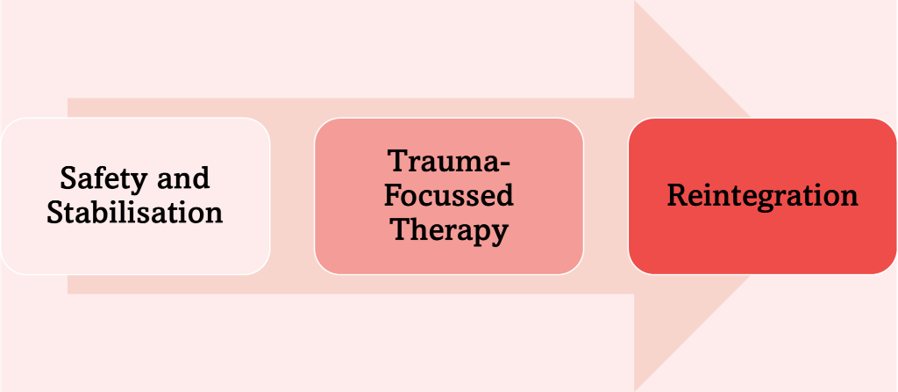
In this post, I explain some of the aims and strategies that are often used in the first stage of trauma therapy. It's all about developing safety and stabilisation. This stage provides the foundation for working with trauma.
Reflecting on your inner experience and patterns of thinking and feeling
Trauma symptoms can feel like a personal failure, like there's something wrong with you. In fact, they are normal and adaptive, and have helped you to survive when you are under threat.
Reflecting on your patterns and experiences can be a helpful way of developing awareness of your tendencies and importantly, in learning their value, how they have supported you, and when they might not be necessary and might even be maladaptive in your life now.
Trauma symptoms can feel like a failure but they are a normal and adaptive response
Learning about how the mind and brain work can be really helpful in letting go of a sense of shame about something that is a normal response to an abnormal situation and makes complete and total sense.
Learning to recognise your own symptoms and how they have helped to protect you from threat or danger can help you to feel empowered and to begin to recognise that you are not a flawed individual.
Emotional awareness and regulation
It's very easy to become stuck in emotions. Developing awareness of them can help to recognise, understand, and respond to them, even when they feel overwhelming.
It's common to be overwhelmed by emotion when you've experienced trauma, and so there might be some resistance to feeling any emotions at all, even positive emotions.
Developing awareness of them can help to understand and respond to them
A trauma therapist can help you to identify and label your emotions, make sense of them, learn what their functions and purpose are, and learn and discover techniques and strategies to help regulate them.
Knowing how and when to apply the brakes
Therapy will work best when working at a pace that feels safe and comfortable for you. Together, you and your therapist can learn what feels manageable for you and what creates emotions that might be too intense.
Therapy works best when working at a pace that feels safe and comfortable for you
You might explore how different feelings at different intensities feel in your body and how it feels when those emotions begin to develop, and how it feels when you begin to feel more comfortable and regulated.
This awareness means that things can be slowed down a little, not because it's not okay to feel intense emotions, but so that you can work through difficulty in a safe and manageable way.
Practicing adaptive coping strategies for dealing with suicidal and self-harming impulses
Sometimes, trauma from the past can feel overwhelming even in the present moment and when we are actually safe. Some people cope with this through harming themselves or thinking about suicide.
These are completely normal and natural responses. However, it is important to develop coping strategies before exploring trauma and its effects in more depth. This is something that can be explored in therapy and includes identifying and creating “safety nets’.
Safety nets are things that can help to cope with urges self-harm or with suicidal thoughts.
It's hard to think about what might be helpful when we're feeling overwhelmed, so developing these with a therapist means that you can draw upon them when you need them.
Each person is different, and so their safety nets will also look different. How we feel and the situation we are in also differs from moment to moment, so having several safety nets can be useful so that you can choose what is best at the time.
Safety nets can be things like: -
- Not being alone
- Having a list of people you can call or message
- Reading a list of things that might be triggering at the beginning of the day - to help you to be prepared and recognise these
- Doing a grounding activity
- Using a “survival kit” - which you and your therapist can work together to create
- Using a feelings thermometer (such as the one below) - to help you to identify the intensity of your feelings and whether you might need to engage in an activity to help you to self-regulate
- Going to A&E

Discovering how to anticipate stressful or triggering events
It's hard to think clearly when overwhelmed, so talking about experiences that have been triggering can be useful in learning to identify what might be stressful or triggering in future.
These might include reminders of past traumatic or difficult experiences, they might be subtle or more obvious, and could be unrelated stressful events, such as a job interview.
Being able to anticipate potential triggers or stressful events means that you can develop more of a sense of control and can plan to take care of yourself before the event.
Learning how to calm the mind and body
Traumatic experiences can interrupt our natural ability to regulate our emotions, so trauma therapy will often involve learning techniques and strategies to help to ground and centre yourself in order to calm the body and mind. Such activities might include things like: -
- Choosing an object in the space around you and describing it in detail (shape, colour, size, texture, etc)
- Activities such as cooking or gardening
- Moving around/changing position
- Holding something cold
- Keeping your feet firmly on the ground
- Pushing your hands flat against a wall for 10 seconds
- Using a weighted blanket
Learning to distinguish between past and present reality and how to stay “in the present”
If you've experienced trauma, you might be familiar with having emotional experiences that feel “out of proportion” to an event or situation, or you might not even know what has caused the feeling. It might be fairly brief and short-lived, or might last for days.
This is very often a trauma-related symptom called a flashback, and learning to identify them can help to bring you back into the present and help you to feel safer.
Flashbacks are often thought of as a visual image that has a clear narrative, but flashbacks are very often emotional and can involve a sense of feeling under threat or in danger, somehow.
It can be helpful to explore how you experience symptoms that are related to past events when you weren't safe, so that you can recognise safety in the moment and stay present with your experience.
Mindfulness
For some people, mindfulness-based practices can be helpful. It is important to note that mindfulness is not helpful for all people at all times, but they can help to practise staying present and regulating thoughts and emotions.
As an accredited mindfulness teacher with trauma-sensitive mindfulness teacher training, I sometimes incorporate this into therapy and clients have often found this very helpful. However, the suitability of mindfulness differs from one individual to the next.
I would be happy to discuss this if you are curious about it and would like to know more.
If you have any questions, feel free to get in touch!
A very informative and detailed blog outlining exactly what Therapy is and the benefits on offer
That’s amazing! I’ve learnt more tips on how to handle my emotions in the beginning of the negative situation.
Thank you, Rebecca!